Your water / The hot tank
What should your water heater be set to, and why?
the water heater setting CPSC urges, to cut scald risk
Hard water and your water heater meet at two numbers: CPSC urges a 120°F setting, and hardness drives scale, 9.0 grains on average at the Potomac plant and 4.1 at Patuxent (our arithmetic).
By the Your Water Numbers desk, not WSSC Water · Updated · How we check
Look up your setting: how fast hot water burns an adult
| Water temp | Third-degree burn in | Note |
|---|---|---|
| 150°F | 2 seconds | Most adults, per CPSC |
| 140°F | 6 seconds | Most adults, per CPSC |
| 130°F | 30 seconds | Most adults, per CPSC |
| 120°F | 5 minutes | The setting CPSC urges |
Source: CPSC, Avoiding Tap Water Scalds · Publication 5098
Reading this: Burn times shorten fast above 120°F. Children under five and older adults make up most of the injuries and deaths, so test the water by hand before a bath.
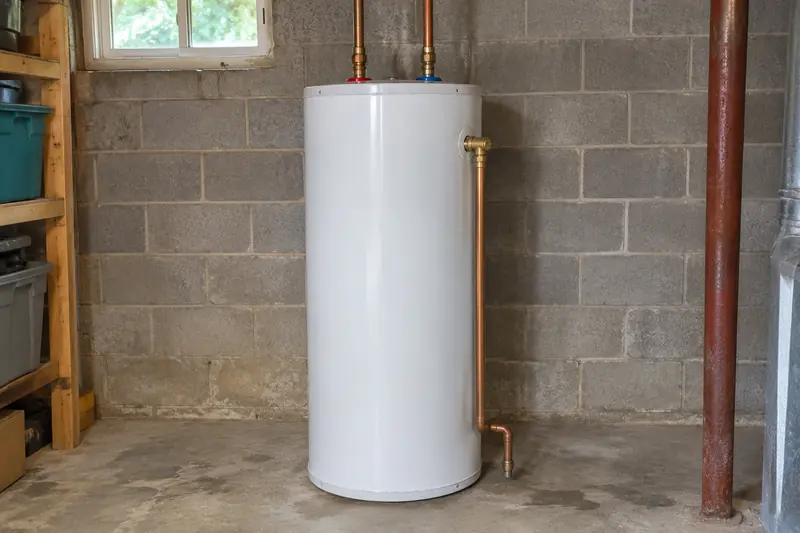
If you smell gas, what do you do first?
Leave the house first. Don’t touch a switch and don’t use a phone inside. From outside, call 911 and Washington Gas. Don’t go back to check the heater.
How do you check the temperature?
Use a candy or meat thermometer at a faucet. CPSC says to take the reading first thing in the morning, or at least two hours after water use.
If it reads high, here’s who adjusts it:
- Gas heater: ask your gas company or a licensed plumber to set it. We give no steps for the gas control.
- Electric heater: CPSC suggests your electric company. You can switch the breaker off, and our advice stops there. The thermostats sit behind panels near live wiring, so leave those to a licensed person.
CPSC notes that a lower setting also saves energy and money.
Source: CPSC, Avoiding Tap Water Scalds · Publication 5098
How much does your plant’s hardness matter?
More on Potomac water than on Patuxent water. Hardness averages 154 mg/L on Potomac and 70 mg/L on Patuxent in the 2025 tap report. That’s 9.0 and 4.1 grains by our arithmetic, up to 12.5 at Potomac’s high.
USGS ties hard water to scale in pipes and water heaters. We have no local figure for how much scale forms, how much efficiency it costs or how long a heater lasts. Treat any such number you hear with care.
Source: Our arithmetic from WSSC Water’s hardness figures · Yearly figures
Do you need a softener because of the heater?
Usually not on Patuxent, and not automatically on Potomac. Look at your aerators and showerheads first. If they stay fairly clean, a softener for the heater’s sake is hard to justify. If you’re at the Potomac end and scale keeps coming back, read our hardness page for the numbers before deciding.
For tank flushing, ask a licensed plumber; we give no steps here. We found no official interval that applies to all homes.
What work has to be licensed?
All gas work does, including swapping a gas water heater. In Montgomery and Prince George’s, plumbing and fuel gas work requires a WSSC Water license and insurance. Gas work needs a registered gasfitter, a permit and an inspection, and first-time or replacement gas appliances get inspected within 10 business days.
- Gas connections and venting: licensed work, always.
- Burners and gas valves: leave them alone.
- Relief valve: never cap it or plug it, even if it’s dripping. A drip is a reason to call a licensed plumber.
Homeowner exemptions aren’t something we could confirm, so ask WSSC Water plumbing inspections. See hiring a licensed plumber for what to ask. If water is pouring out, turn it off at the house valve.
What does a replacement look like?
Two links show the parts, so you can follow what a plumber quotes. They aren’t a suggestion to install anything yourself.
What to do with this number
- Read the hot tap with a thermometer
- Adjust through your gas or electric company, or a licensed person
- Look at the relief valve for any cap or plug, and call a plumber if you find one
Questions on this page
Is 120°F completely scald-proof?
No. CPSC says a five-minute exposure at 120 degrees could still cause third-degree burns, so always hand-test a bath.
Can I go lower than 120°F?
CPSC suggests the lowest setting that still meets your washing needs. Check your dishwasher and washer directions too.
My relief valve drips. Can I plug it for now?
Never. A plugged relief valve removes a safety device on the tank. Call a licensed plumber about the drip.
Where each number comes from
| Figure | What it is | Source | As of |
|---|---|---|---|
| 150°F 2 s; 140°F 6 s; 130°F 30 s; 120°F 5 min | Time to third-degree burn | CPSC Publication 5098 | 2012 print |
| 120°F | Setting CPSC urges | CPSC Publication 5098 | 2012 print |
| 154 and 70 mg/L; 213 high | Hardness at each plant | WSSC Water 2025 tap report | Yearly figures |
| 9.0, 4.1, 12.5 grains | Hardness ÷ 17.1 | Our arithmetic | Recent figures |
| 10 business days | Gas appliance inspection | WSSC Water gas inspection rules | via search index, Nov. 2026 |