Your bill / High bill
Your bill jumped. Here is the order to check things.
daily use against the same season last year, the adjustment line
On a WSSC Water high bill you owe what the meter registered, leaks included, though an adjustment exists when your daily average reaches at least 3× the same season a year earlier.
By the Your Water Numbers desk, not WSSC Water · Updated · How we check
Look up your number: where the 3× line falls
| Last year, gal/day | 3× line, gal/day | 90-day bill at the line | Note |
|---|---|---|---|
| 40 | 120 | $274.14 | $136.32 above that home’s usual bill |
| 60 | 180 | $387.55 | $217.51 above usual |
| 80 | 240 | $518.40 | $316.14 above usual |
| 100 | 300 | $662.82 | $424.72 above usual |
| 145 | 435 | $1,033.64 | $714.46 above usual |
| 200 | 600 | $1,486.86 | $1,055.70 above usual |
Source: Our arithmetic; the 3× test is from the billing adjustment page · FY27 rates, 5/8-inch meter
Reading this: Use the same season, not last quarter. A bill under the line can still be a real problem, but this particular adjustment would not fit it.
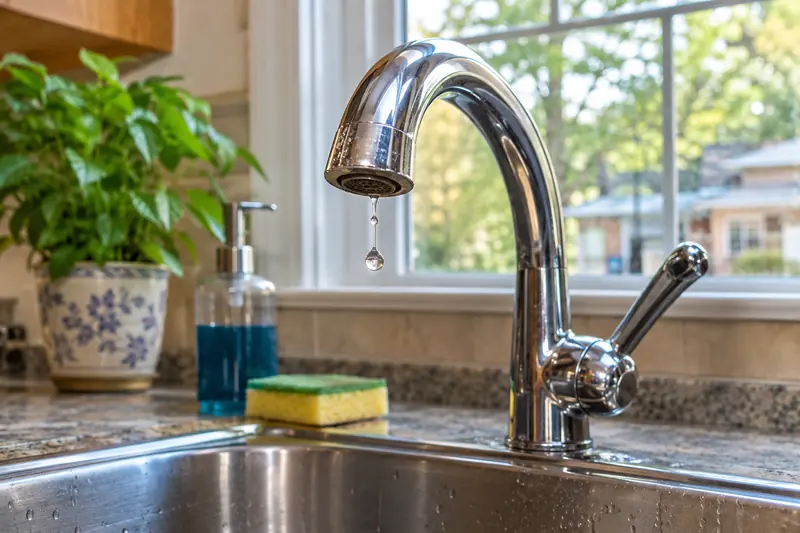
Did your gallons rise, or only your dollars?
Check gallons first. Divide the gallons on this bill by its days, then do the same for the same season a year ago.
If gallons held steady, the cause is price. FY27 added $14.44 at 145 gallons a day (our arithmetic), and the rate history shows the rest. A 5.0% rise cannot double a bill.
How do you test for a leak?
Read the meter, use no water for 2 hours, read it again. Don’t open an outside meter box; if you can’t read it, ask WSSC Water. A leak-free home shows no change.
Then test toilets. Put dye in the tank and wait without flushing. The WSSC Water billing guide says 20 minutes and EPA says 10; use the longer wait. Color in the bowl points to a leak.
Not sure where the meter is, or whose job a pipe is? Who owns which pipe sorts that out.
Which leaks are big enough to explain it?
Size decides. On a 145-gallon-a-day house, a 90-day bill grows by (our arithmetic):
- $14.41 for 8 gallons a day, about a drip per second
- $57.46 for a worn flapper, near 30 gallons a day
- $467.24 for a running toilet, near 200 gallons a day
- $741.92 for 300 gallons a day
So a dripping faucet alone rarely explains a shock. The leak cost table has the rest. A sprinkler can do it too: see summer watering.
Can you get an adjustment?
Possibly, and the terms are specific. The default is that owners pay for water registering on the meter, leaks included. The unexplained-high-bill path is the exception:
- Daily average at least 3× the same season’s average a year earlier
- If there is no year-earlier figure, the page refers to current average use; ask how that applies
- Single-unit residential homes
- Once, covering up to two consecutive billing periods, in a three-year period
- No plumber invoice or permit needed for this type
- Include a current meter reading if your meter is inside
The rule is cited to WSSC Water Code of Regulations Ch. 3.20.030. An inspector general audit covers the same topic.
A temporary program used 2.5×. It was time-limited, so confirm whether it still runs before counting on it.
Is there another route if money is the problem?
Yes, if you qualify. The Customer Assistance Program can remove excess usage charges for one billing cycle in any 3-year period, and it includes a free annual plumbing leak investigation.
If you can’t find the leak yourself
Stop guessing and hire it out. Plumbing work in Prince George’s and Montgomery counties requires a WSSC Water license and insurance; hiring a licensed plumber covers how to check one.
What to do with this number
- Work out this bill’s gallons a day and last year’s
- Run the 2-hour meter test and the toilet dye test
- Fix what you find, then keep the paperwork anyway
- If you pass the 3× line, file the adjustment request with a meter reading if the meter is inside
Questions on this page
Do I need a plumber’s invoice to ask for the unexplained-high-bill adjustment?
Not for that type, per the adjustment page. Other adjustment types may differ, so read the form for yours.
Can I use the adjustment twice?
It is once, for up to two consecutive billing periods, in a three-year period.
Does my townhouse qualify?
The page says single-unit residential. Whether your property counts is a question for WSSC Water’s billing staff.
Where each number comes from
| Figure | What it is | Source | As of |
|---|---|---|---|
| 3×, once in three years | Unexplained-high-bill adjustment terms | WSSC Water adjustment page | via search index, Nov. 2026 |
| Ch. 3.20.030; 2.5× | Regulation and temporary program | Office of the Inspector General audit | December 2025 |
| 20 minutes; 2 hours | Leak tests | WSSC Water billing guide | older guide |
| 10 minutes; over 3,000 gal a year | Dye test wait; a drip per second | EPA on household leaks | checked this month |
| About 30 and 200 gal/day | Flapper and running toilet, EPA pages linked in the text | EPA WaterSense leak device guide | see that page |
| Bills at the line, leak dollars | From the tier table | Our arithmetic from WSSC rates | fall 2026 |