Your water / Lead at the tap
What the lead number says, and what it can’t
90th-percentile lead, 69 sites; a system figure, not your tap
WSSC Water lead results put the 90th percentile below 2 ppb across 69 sites in the 2023 round, but that is a system figure and cannot tell you what comes out of your own tap.
By the Your Water Numbers desk, not WSSC Water · Updated · How we check
Look up the figure: lead and copper in the latest required round
| Line | Figure | Limit or goal | Note |
|---|---|---|---|
| Lead at the 90th percentile | Under 0.002 mg/L (2 ppb) | Action level 15 ppb | Sites, not your home |
| Copper, 90th percentile | 0.12 mg/L | Action level 1.3 mg/L | Same sites |
| Sites over either level | 0 of 69 | None | June–Sept 2023 |
| EPA health goal for lead | Zero | Goal, not a limit | EPA sets it at zero |
| Inventory confirmed non-lead | 97.3% | None | At Apr 30, 2025 |
| Lines with an unknown side | 11,512 | None | At Apr 30, 2025 |
Source: WSSC Water 2025 quality report · 2023 sampling round
Reading this: An action level is a trigger for the utility, not a safe line. EPA’s goal for lead is zero, and for a child’s blood EPA knows of no safe level.
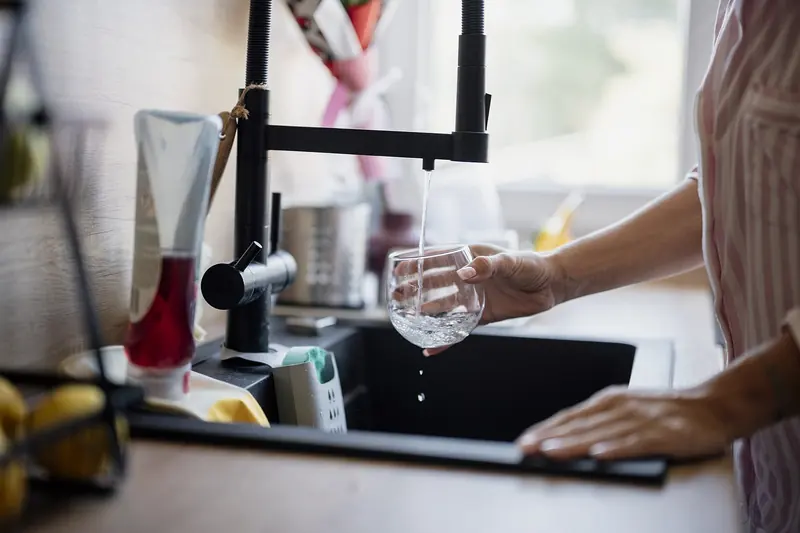
What does "below 2 ppb" actually cover?
It covers 69 sites in the round of June–September 2023, the latest required one in WSSC Water’s 2025 report. The 90th percentile means nine samples in ten came in at or under that figure.
None of the 69 went over either action level. That’s useful news about the system. It isn’t a test of your house, your faucet or your solder.
Why can your glass differ from the system figure?
Because lead usually enters after the water leaves the plant. That same report describes plant water as free of lead when it goes out, and the utility removed known lead pipes from its distribution system in the early 2000s.
What remains is on the way to your tap. EPA points to homes built before 1986, brass or chrome faucets and lead solder. Infants, young children and fetuses are the most vulnerable.
What does EPA tell you to do?
Start with these steps, alone or together. EPA also suggests contacting your water system and health department.
- Use only cold water for drinking, cooking and baby formula.
- Don’t count on boiling. Boiling does not remove lead.
- Run the water before drinking if it has been sitting. A shower, laundry or a load of dishes also flushes the pipes. The time depends on your pipes, so ask WSSC Water.
- Clean the faucet aerator regularly. Lead particles can collect in the screen.
- If you use a filter, get one certified for lead, follow the directions, change cartridges on time and don’t run hot water through it.
- Watch for nearby construction if you have a lead line, since it can disturb the pipe.
Which filter counts?
Look for a certification to NSF/ANSI 53 for lead. A claim on a box isn’t the same thing. EPA keeps a consumer tool for point-of-use and pitcher filters certified to reduce lead.
If you’ve tested and have no lead concern, you may not need one. If you have a baby on formula in an older home, testing and a certified filter are both reasonable steps while you wait for answers.
How do you test one tap?
Ask WSSC Water first, and use a certified lab. EPA says testing is the only sure way to know, and that your state or local drinking water authority has lab lists. It puts the cost at $20 to $100.
Follow the lab’s sampling directions exactly. One result describes that tap on that day.
What about the service line?
Leave it alone. Never dig at it, cut it or try to replace it yourself. Find out what it’s made of through WSSC Water’s pipe verification and read our service line inventory page.
The counts changed over time, so keep the dates attached. On April 30, 2025 the dashboard had 97.3% confirmed non-lead and 11,512 lines unknown on one or both sides. Field checks had turned up no lead line by then. The November 2025 notice page moved about 6,000 unknowns to non-lead and adds two finds: a lead connector, and a lead service line that a plumber came across on a routine visit.
If yours turns out to be lead, tell WSSC Water before any work on your side, because EPA wants both sides replaced and the utility recommends replacement. The EPA rule sets 10 years for lead pipes, and the utility plans to finish by EPA’s date of 2037.
Any work on your side goes through a licensed plumber. Start with who owns which pipe.
What to do with this number
- Ask WSSC Water what your line is made of
- Use cold water for drinking, cooking and formula, starting now
- Ask WSSC Water about flushing time and a certified lab
- Replace filter cartridges on schedule
Questions on this page
Does 0 of 69 mean my house is fine?
No. Those are sites in a 2023 round, and your faucets, solder and service line weren’t among them unless you were one of the 69.
Does hot water from the tap make a safe shortcut for cooking?
No. Start with cold water for drinking, cooking and formula, and heat it afterward. Boiling won’t take lead out.
Will a softener or a carbon filter deal with lead?
Only rely on a filter certified to NSF/ANSI 53 for lead. Check the certification itself, whatever the product type.
Got a letter about an unknown line. Is that a lead finding?
No. The utility sends letters each year on lead, galvanized requiring replacement and unknown lines until each is confirmed. Answer it and verify the material.
Where each number comes from
| Figure | What it is | Source | As of |
|---|---|---|---|
| Below 0.002 mg/L (2 ppb); 15 ppb | 90th-percentile lead and action level | WSSC Water 2025 quality report | June–Sept 2023 |
| 0.12 and 1.3 mg/L; 0 of 69 | Copper, action level, sites over | WSSC Water 2025 quality report | June–Sept 2023 |
| 97.3%; 11,512 | Inventory status | WSSC Water pipe type dashboard | Apr 30, 2025 |
| About 6,000 and two finds | Notice page counts | WSSC Water annual notifications | Nov 2025 |
| Zero; before 1986; $20 to $100 | Health goal, older homes, test cost | EPA, lead in drinking water | As read |
| 10 years; 2037 | Lead pipe replacement window and date | EPA lead rule; WSSC Water overview | As read |
| NSF/ANSI 53 | Filter certification for lead | EPA consumer tool | Read Nov 2026 |