Your bill / Leak cost
What a running toilet adds to your bill
added per 90-day bill by 200 gallons a day, our arithmetic
A running toilet cost about $467.24 extra per 90-day WSSC Water bill at 200 gallons a day on a 145-gallon-a-day house, by our arithmetic; a worn flapper at 30 gallons adds $57.46.
By the Your Water Numbers desk, not WSSC Water · Updated · How we check
Look up your number: leak size to extra dollars per 90-day bill
| Leak, gal/day | 145 gal/day house | 80 gal/day house | Note |
|---|---|---|---|
| 8 | +$14.41 | +$14.22 | About a drip per second |
| 25 | +$46.56 | +$44.85 | About EPA’s average home leak |
| 30 | +$57.46 | +$53.86 | Worn flapper |
| 50 | +$101.08 | +$89.90 | 9% of homes waste 50 or more |
| 100 | +$210.11 | +$185.29 | Tier 3 on the bigger house |
| 200 | +$467.24 | +$405.63 | Running toilet, older EPA figure |
| 300 | +$741.92 | +$680.31 | Top tier on both |
| 500 | +$1,291.28 | +$1,229.67 | Nearly all in the top tier |
| 720 | +$1,895.58 | +$1,833.96 | Fill valve stuck at 0.5 gpm |
Source: Our arithmetic; leak sizes from EPA · FY27 rates, leak running the whole 90 days
Reading this: Pick your house’s normal use in the column head, then your leak size. A leak that ran only half the period costs less than half, because of the tiers.
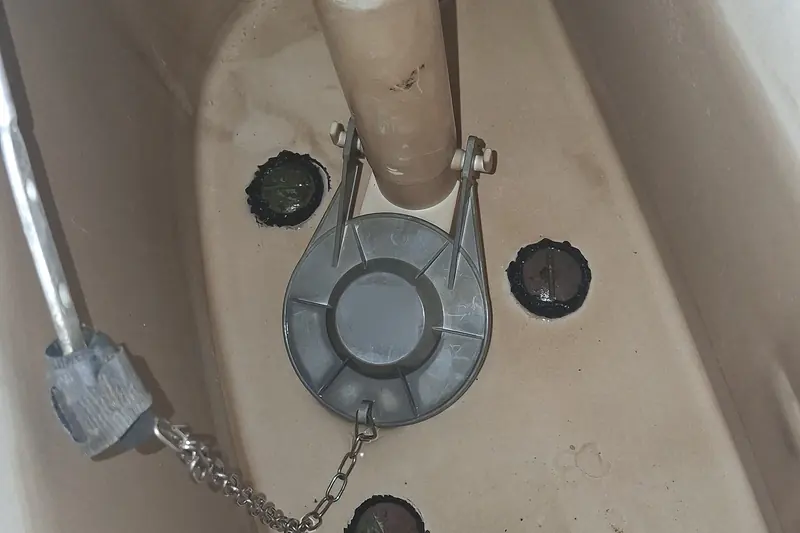
How big is a typical toilet leak?
EPA’s figures run from about 30 to about 200 gallons a day, and higher for a stuck fill valve. Its leak device guide puts a worn flapper at about 30 gallons a day, almost 900 a month. An older EPA page puts a running toilet at about 200.
The same guide says about 20% of toilets leak, and a constantly running fill valve passes 0.5 to 3 gallons a minute, up to 4,300 gallons a day. Left running at that ceiling for 90 days, it would add about $11,700 (our arithmetic).
Why do larger leaks cost more per gallon?
Because they push your last slice into pricier rate tiers. A small leak on a 145-gallon house mostly pays $20.02 per 1,000 gallons. A big one reaches $30.52.
Source: Our arithmetic, leak dollars over leak gallons · 145 gal/day house, 90-day bill
What does leaving it for a year cost?
Multiply by four. A worn flapper comes to $229.84 a year on the 145-gallon house and a 200-gallon running toilet to $1,868.96 (our arithmetic).
Compare that with EPA’s advice to replace a flapper at least every five years. EPA says fixing leaks saves about 10%.
Source: Our arithmetic, both house sizes · extra per 90-day bill
Is your toilet the leak?
Run the dye test: color in the tank, no flushing, then look at the bowl. EPA waits 10 minutes and the WSSC Water billing guide waits 20. The fuller check, with the 2-hour meter reading, is on the high bill page.
What if the meter moves and toilets pass?
Then it may be elsewhere, including out of sight. Owners pay for what registers on the meter, and the line from the property line into the house is the owner’s.
Bring in a licensed plumber for hidden leaks. We could not confirm what homeowners may do themselves under the plumbing code, so ask WSSC Water’s plumbing inspections about anything beyond a tank part. If money is the barrier, CAP Leak Repair exists for those who qualify.
What to do with this number
- Dye-test every toilet in the house this week
- Read the meter before and after 2 hours of no use
- Look up your leak size above and compare it with your bill’s jump
- Swap a flapper that has passed five years
Questions on this page
Does a toilet leak on an upstairs bathroom cost the same as one in the basement?
Yes. The meter only counts gallons, so the location changes nothing on the bill.
Why is the extra smaller on the 80-gallon house?
It starts lower in the tier table, so more of the leak is priced at the cheaper rates.
How much of a winter bill might be a leak?
EPA’s flag is a family of four above 12,000 gallons in a winter month, or 400 a day by our arithmetic.
Can I get money back for a leak I fixed?
Owners pay for water that registers, but the high bill page above sets out the adjustment line and its terms.
Where each number comes from
| Figure | What it is | Source | As of |
|---|---|---|---|
| About 30 gal/day; 0.5–3 gpm; 4,300 gal/day; 20% | Flapper and fill valve flows, share of toilets leaking | EPA WaterSense leak device guide | Feb. 2026 |
| About 200 gal/day | Running toilet, older figure | Archived EPA fix-a-leak page | 2017 snapshot |
| 9,300 gal; 9%; 3,000 gal; 10%; five years; 12,000 gal | Leak rates and flapper advice | EPA, Fix a Leak | as read Nov. 2026 |
| Owners pay for registered water | Billing rule, linked in the text | WSSC Water billing adjustments | see that page |
| All dollar rows | Added cost per 90-day bill | Our arithmetic from WSSC rates | leak table rows |